
The Ultimate Guide: How to Choose the Right Home Theater Audio for Your Room Size

When building a Home Theater Audio, it’s easy to get caught up in brand names, amplifier power, and flashy speaker cones. But here is the industry’s worst-kept secret: the most expensive audio system will sound mediocre if it is forced into the wrong room.
In high-end acoustic engineering, the room is the final component of your sound system. If the room is small, oversized speakers will create a boomy, muddy mess. If the room is massive, undersized speakers will sound thin and hollow.
To get that bone-rattling, crystal-clear cinematic immersion, you need to match your audio configuration to your specific square footage. Here is exactly how to do it.

1. Compact Rooms: The Cozy Cinema
Average Dimensions: 10' × 12' to 12' × 15' (Approx. 120 – 180 sq. ft.)
Common Spaces: Spare bedrooms, small basement corners, or luxury apartment dens.
In a smaller space, sound waves travel short distances and bounce off walls quickly. Your main challenge here isn't getting enough volume—it's preventing acoustic clutter and excessive bass reflections.
The Ideal Audio Setup: Premium 5.1 Surround Sound
A classic 5.1 setup (Front Left/Right, Center channel, two Rear Surrounds, and one Subwoofer) is the absolute sweet spot here.
Speaker Choice: Opt for high-performance bookshelf speakers or sleek, architectural in-wall speakers. Massive floor-standing towers will overwhelm the room visually and sonically.
The Subwoofer Factor: A single 8-inch or 10-inch subwoofer is more than enough to handle the low frequencies without shaking the drywall loose.
Pro Tip: Because your seating is likely close to the back wall, keep your surround speakers slightly above ear level and angled inward to create a proper sense of space.
2. Medium Rooms : The Sweet Spot
Average Dimensions: 12' × 16' to 16' × 22' (Approx. 200 – 350 sq. ft.)
Common Spaces: Dedicated media rooms, deep basements, or converted garages.
This is where true commercial-grade cinema tech can begin to flex its muscles. A medium-sized room gives you enough physical depth to separate the seating rows from the walls, which is essential for advanced directional audio.
The Ideal Audio Setup: 7.1 or 5.1.2 / 7.2.4 Dolby Atmos
With more air to move, you can move away from traditional surround sound and step into spatial audio.
Speaker Choice: You can now comfortably introduce mid-to-large floor-standing tower speakers for the front left and right channels to build a massive soundstage.
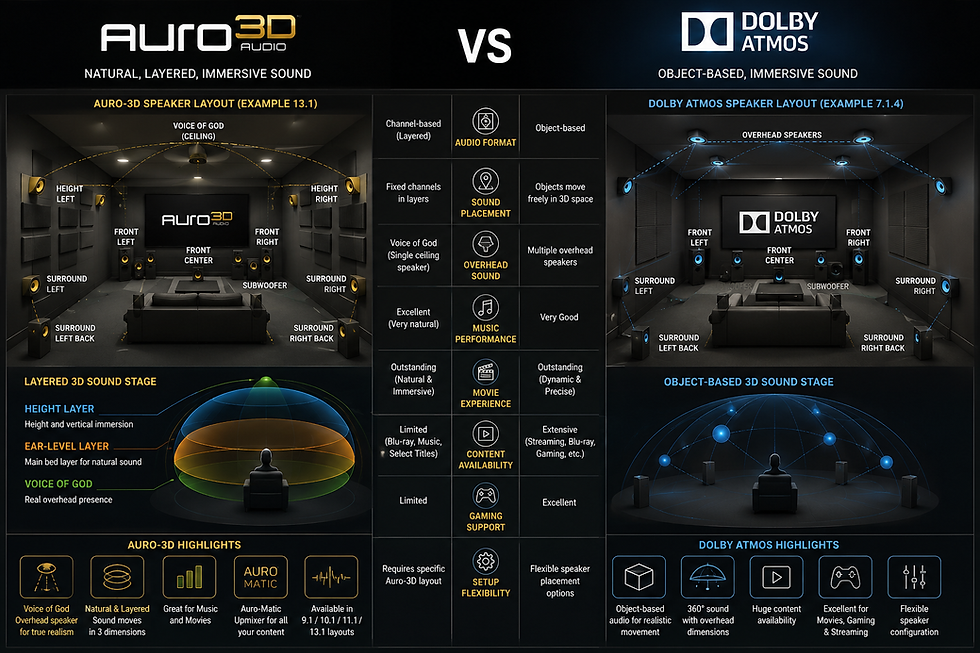
The Atmos Advantage: This room size is ideal for overhead or in-ceiling speakers. A 5.1.2 or 7.2.4 Dolby Atmos configuration adds a vertical layer of sound—so when a helicopter flies overhead onscreen, you actually hear it above you.
Dual Subwoofers (The .2): In a 200+ sq. ft. room, a single subwoofer can create "bass dead zones" where certain seats feel no punch. Upgrading to dual subwoofers smooths out the bass response across every seat in the room.
3. Large & Open-Concept Room Home Theater Audio: The Grand Theater
Average Dimensions: 20' × 25' and above (500+ sq. ft.)
Common Spaces: Tiered dedicated home theaters, large open-plan living zones, or estate entertainment wings.
Large rooms require an immense amount of acoustic energy to fill the space. If your audio system lacks power or speaker surface area, the dialogue will sound lost, and action sequences will lack physical impact.
The Ideal Audio Setup: 9.4.6 or IMAX Enhanced Systems
For grand spaces, you want an array of speakers that completely envelop multiple rows of tiered seating.
Speaker Choice: High-sensitivity, high-output floor-standing towers or massive behind-the-screen cinema arrays are required.
The Bass Foundation: Large rooms need severe air movement. Deploying four subwoofers (a quad-sub setup) placed strategically in corners or mid-wall points ensures that low-end frequencies ($20\text{ Hz} - 80\text{ Hz}$) feel uniformly tight and physical, rather than boomy.
Acoustic Treatment is Mandatory: Massive rooms inherently suffer from echo. To match your heavy-duty Home Theater Audio array, you must budget for professional acoustic paneling, fabric walls, and bass traps to tame the reflections.
Quick Reference Matrix
Room Tier | Square Footage | Best Layout Configuration | Recommended Speaker Types |
Small | 120 – 180 sq. ft. | 5.1 Surround | Bookshelf / High-end In-Wall + 1 Sub |
Medium | 200 – 350 sq. ft. | 5.1.2 or 7.2.4 Dolby Atmos | Floor-standing Towers + In-Ceiling + 2 Subs |
Large | 500+ sq. ft. | 9.4.6 / Custom Cinema Array | High-output Arrays + Heavy Acoustic Panels + 4 Subs |
Home Theatres Hyderabad :- https://www.hometheatreshyderabad.com/



Comments